IEMT – Integral Eye Movement Technique

Helping Change the Way Difficult Feelings and Memories Affect You

Looking for IEMT Leicester services? I offer Integral Eye Movement Technique for people who want to explore a different way of working with difficult feelings, memories and emotional patterns.

Sometimes you know logically that something is in the past, yet the feelings connected to it can still seem very present.

A memory, situation, thought or trigger can bring back anxiety, fear, anger, guilt, shame or another uncomfortable emotional response — sometimes before you’ve even had time to think about it.

IEMT (Integral Eye Movement Technique) is a structured approach that uses guided eye movements alongside carefully chosen questions to explore how these emotional patterns are experienced.

It can be particularly appealing to people who don’t want to spend session after session talking in detail about everything that has happened to them.

What Is IEMT – Integral Eye Movement Technique?

IEMT stands for Integral Eye Movement Technique and was developed by Andrew T. Austin.

It explores the way particular emotional responses and patterns can become associated with memories, experiences and the way we think and feel about ourselves.

During IEMT, I will guide your eyes through a series of movements while asking you to notice aspects of an internal experience.

You remain awake, aware and in control throughout.

Unlike hypnotherapy, you don’t enter hypnosis, and you don’t necessarily have to tell me every detail of the experience you’re working with.

For some people, that alone can make IEMT feel like a more comfortable approach.

Integral Eye Movement Technique IEMT
Association for IEMT Practitioners member

How Does IEMT Work?

Have you ever remembered something that happened years ago and noticed that your body still responds to it?

Perhaps your stomach tightens, your chest feels different, your heart beats faster or an uncomfortable feeling seems to appear almost instantly.

The event may be over, but something about the emotional response has remained.

IEMT works with these kinds of learned emotional patterns.

Rather than concentrating only on what happened, we can become interested in questions such as:

How did you learn to feel this way about this?

Using structured questions and guided eye movements, we explore what happens to the emotional experience as you process it differently.

The aim isn’t to erase your memories. What happened remains part of your life story.

Instead, we’re looking at whether the emotional intensity attached to something can change, so that remembering something doesn’t necessarily have to mean experiencing it in quite the same way.

What Can IEMT Be Used For?

People may explore IEMT when they’re experiencing persistent or unwanted emotional responses connected with things such as:

Anxiety • Fear • Anger • Guilt • Shame • Stress • Difficult Memories • Emotional Triggers • Phobias • Loss • Confidence • Unhelpful Emotional Patterns

Every person and every situation is different, and IEMT isn’t suitable for everybody or guaranteed to produce a particular result.

During your initial consultation, we can talk about what’s happening for you and whether IEMT, hypnotherapy, EMDR-based techniques or another approach I offer may be appropriate.

Difficult Memories Without Having to Tell Me Everything

One aspect of IEMT that some people particularly appreciate is that you don’t always need to describe the full content of a difficult memory to me.

There may be things in your past that you simply don’t want to discuss in detail.

That’s okay.

I may need enough information to understand what you’re experiencing and to work appropriately and safely with you, but I don’t necessarily need every detail of the event itself.

For somebody who finds talking repeatedly about the past uncomfortable, this can make IEMT an interesting option to explore.

What Happens During an IEMT Session?

We’ll begin by talking about what you’d like help with and identifying the emotional response or pattern we’d like to explore.

I’ll then ask you to bring your attention to certain aspects of that experience.

Using my hand or fingers as a visual guide, I’ll ask you to follow a series of movements with your eyes while keeping your head relatively still.

From time to time we’ll pause and notice what has changed.

You may notice a difference in the intensity of a feeling, the way a memory appears, where you experience something in your body, or the meaning you attach to it.

Sometimes changes can feel quite noticeable. At other times they may be more subtle.

There is no particular response you have to produce and nothing you need to force.

We simply work with what happens for you.

IEMT Leicester eye movement therapy session
IEMT and hypnotherapy techniques

IEMT and Hypnotherapy – What’s the Difference?

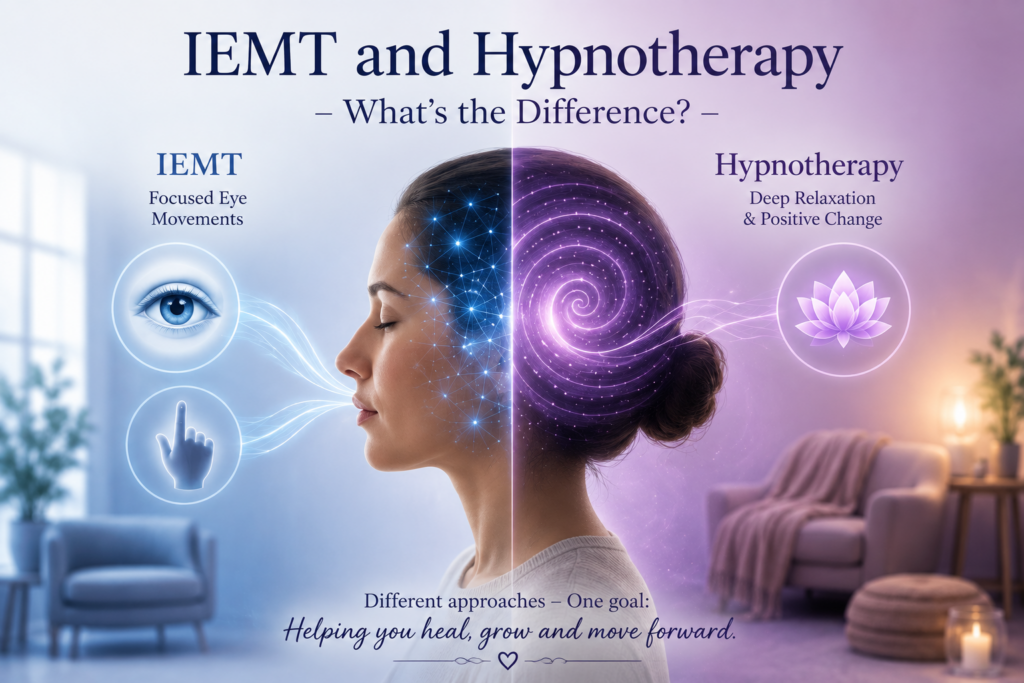
Although I offer both IEMT and hypnotherapy, they’re different approaches.

With hypnotherapy, I use hypnosis and therapeutic suggestion to work with subconscious thoughts, feelings, habits and responses.

With IEMT, you remain fully awake and follow structured eye movements while we explore particular emotional or identity patterns.

Some people are fascinated by hypnosis and love the idea of experiencing it.

Others simply don’t fancy it!

And that’s absolutely fine.

I don’t believe everybody has to fit the same therapeutic approach.

Sometimes I may predominantly use hypnotherapy. Sometimes IEMT may be appropriate, and on other occasions I may draw upon different techniques according to the person sitting in front of me.

So if hypnotherapy isn’t for you, maybe I can still help.

Is IEMT the Same as EMDR?

No. Although IEMT and EMDR both use eye movements, they are different approaches with different methods and ways of working.

Alongside my IEMT training, I also hold a qualification in EMDR with Hypnotherapy, which included training in EMDR-based eye movement techniques that can be incorporated into hypnotherapy where appropriate.

This gives me a range of techniques to draw upon rather than feeling that every person needs exactly the same approach.

Depending on what you’re experiencing, I may use IEMT, hypnotherapy, EMDR-based techniques, or a combination of approaches within my training and experience.

We’ll always discuss what we’re doing, and you’ll remain in control throughout.

Do I Have to Relive a Difficult Experience?

The purpose isn’t to make you repeatedly relive something distressing.

You may need to bring an experience or feeling to mind sufficiently for us to work with it, but IEMT can often be carried out without you giving me a detailed verbal account of everything that happened.

If at any point you feel uncomfortable, you remain in control and can ask to pause or stop.

Will I Forget What Happened?

No.

IEMT isn’t about deleting memories.

A memory remains part of your personal history.

What we’re interested in is whether the emotional response associated with that memory can become different, so that the past doesn’t necessarily have the same influence over how you feel in the present.

How Many Sessions Will I Need?

There isn’t one answer because people and problems are different.

Some people choose IEMT for a very specific emotional response, while others have more complex or longstanding patterns that require broader therapeutic work.

We’ll discuss what you’re experiencing and decide together how best to proceed.

I don’t believe in promising that everybody will achieve a particular result within a particular number of sessions.

Is IEMT in Leicester Right for Me?

You don’t need to decide that before contacting me.

That’s exactly what the free initial consultation is for.

We can have a relaxed conversation about what’s happening, what you’d like to change and the different ways I may be able to support you.

There is no obligation to book therapy afterwards.

Professional IEMT Membership

I am a member of The Association for IEMT Practitioners, a professional association supporting standards, training and continuing professional development for IEMT practitioners.

You can view my practitioner listing in the Association’s public directory below.

Ready to Find Out More?

If something has been affecting you for a long time, it can be easy to start believing:

“That’s just the way I am.”

But the way you learned to respond to something in the past doesn’t necessarily have to determine how you respond forever.

If you’d like to find out whether IEMT, hypnotherapy, EMDR-based techniques or a combination of approaches might be suitable for you, you’re welcome to get in touch.

Book Your FREE 30-Minute Consultation

Come and have a chat with me and we’ll look at what’s happening, what you’d like to change and what might be the most appropriate way forward.